MAPK - Cultural Infrastructure in Prague: Where Culture Happens
In the MAPK application, you can explore Prague's cultural infrastructure in detail. For example, you can find out what types of cultural facilities exist in the city or how many are located in individual city districts.
Overview of cultural facilities in Prague
MAPK works with a database of cultural facilities in Prague and allows you to view them according to various categories and parameters. What will you find in the database? Facilities in the database are tracked by building rather than by individual institution. Therefore, it is possible to find several cultural facilities of different types within a single building (e.g., the Rudolfinum) or multiple facilities falling under one institution (e.g., the Prague City Gallery).
For example, you can track:
- the distribution of cultural facilities across individual city districts,
- types of cultural facilities and their frequency (such as theaters, galleries, cinemas, cultural centers, or libraries),
- or the representation of individual types of legal entities within the cultural infrastructure.
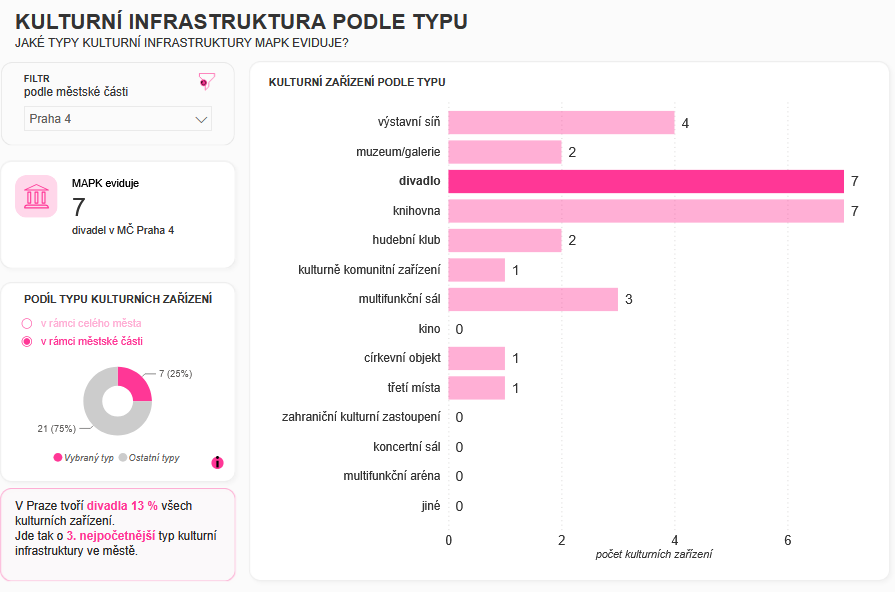
How culture is spread across the city
Prague has long had a very diverse cultural infrastructure that includes a wide range of institutions—from large public organizations to smaller independent spaces.
Thanks to the data managed by Kreativní Praha, it is possible to track where these types of facilities are located in the city and what cultural functions individual parts of Prague fulfill. Some city districts have a significant concentration of large cultural institutions, while elsewhere, smaller local cultural centers or libraries play an important role.
Such a perspective allows for a better understanding of how culture functions in different city neighborhoods and what types of cultural spaces are typical for individual areas.
Data for cultural planning and development
Data on cultural infrastructure are an important foundation for strategic planning of cultural policy and the strategic location of new facilities.
They help, for example, to identify areas where the cultural offering is strong, as well as places where there may be room for further development. An overview of cultural facilities can also assist in planning investments in cultural infrastructure or in supporting local cultural activities.
The systematic collection and analysis of cultural data, which Kreativní Praha focuses on, allows the city to better respond to the needs of both the cultural sector and its residents. Infrastructure data is one of the key areas that MAPK monitors, alongside information on cultural funding, cultural events, and the cultural behavior of residents.
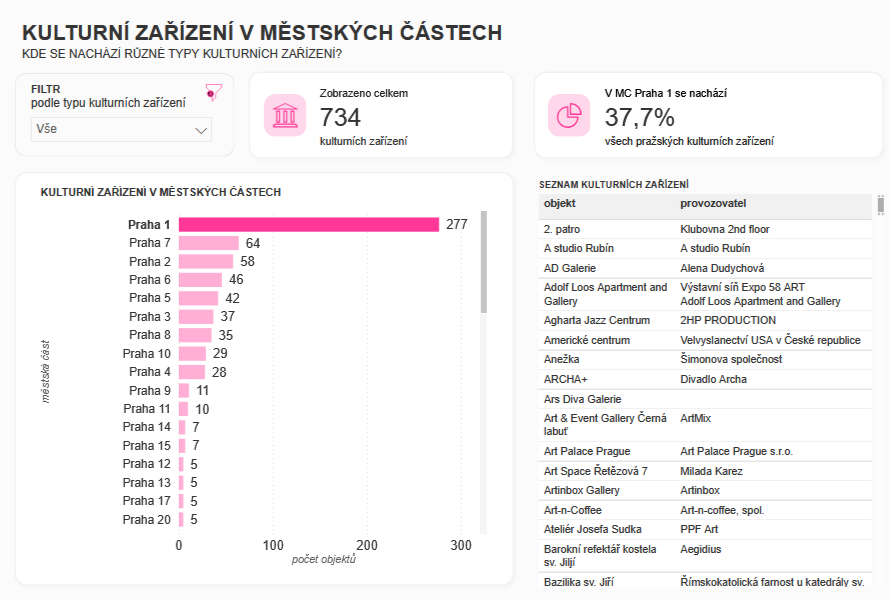
Would you like to learn more?
During 2025, our team conducted a detailed analysis of Prague's cultural infrastructure, the output of which is a study titled How City Districts Contribute to the Cultural Infrastructure Network. If you are interested in this topic, you definitely shouldn't miss it.
You can view data regarding cultural infrastructure, presented clearly and in context, here. The data is updated on an ongoing basis.

